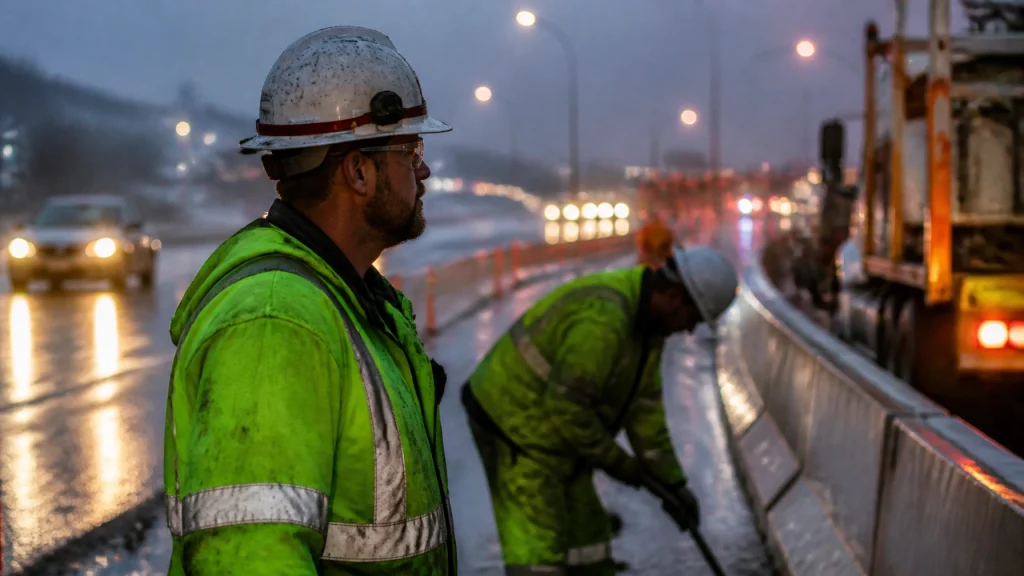
Picture this: It’s 3:00 AM. It’s raining sideways, the kind of rain that feels like Mother Nature is personally offended by your existence. You’re on the side of a highway that’s buzzing with tractor-trailers moving at 70 miles per hour, driven by folks who are on their fourth cup of lukewarm gas station coffee and probably daydreaming about a vacation in Bora Bora.
In this scenario, you don’t want to be "subtle." You don’t want to be "understated." You want to look like a neon supernova that just crashed into a highlighter factory.
Welcome to the world of high-visibility safety apparel (HVSA). It’s not just about wearing a vest that makes you look like a very lost, very bright traffic cone. It’s about science, legal compliance, and, most importantly, making sure everyone on your team goes home in one piece at the end of the shift. (Which is, you know, generally considered a "good thing" in HR handbooks).
At Proforma Awards Print & Promotions, we’ve seen it all. We’ve seen the "oops, I forgot my vest" face and the "why does this Class 3 jacket weigh more than my toddler?" face. Today, we’re stripping back the jargon and giving you the ultimate guide to mastering workwear compliance.
Let’s dive in.
Why Your Brand Needs More Than Just "Bright Stuff"
Listen, I get it. Nobody wakes up and thinks, "I can’t wait to put on a polyester garment that creates enough static electricity to power a small village." But here’s the kicker: safety apparel isn’t a fashion statement; it’s a force field.
When we talk about "compliance," we aren’t just trying to make the bureaucrats happy (though that’s a nice side effect). We’re talking about the ANSI/ISEA 107-2020 standard. It’s a mouthful, right? Think of it as the "Ten Commandments" of glowing clothes. This standard dictates exactly how much fluorescent background material and how much retroreflective tape a garment needs to keep you visible in different environments.
If you’re running a business, neglecting this isn’t just risky, it’s a one-way ticket to a "chat" with OSHA that will make your bank account weep. Plus, a solid safety incentive program can actually boost morale. Who doesn't love getting rewarded for not getting hit by a forklift?
Simple. Genius. Impact.
The "Holy Trinity" of Safety Classes
Not all neon is created equal. If you show up to a high-speed highway construction site in a Class 1 vest, you might as well be wearing camouflage. Let's break down the classes like we’re sorting laundry, but with much higher stakes.

Class 1: The "Parking Lot Vibes"
Class 1 is for when the risks are low and the traffic is slow. Think under 25 mph. This is for the parking lot attendants, the warehouse pickers in areas with minimal forklift traffic, or the off-road utility workers who are far enough away from the "zoom-zooms" to feel safe.
- The Look: Minimal reflective tape, enough to say "Hey, I'm here," but not enough to be seen from space.
- The Vibe: Casual Friday, but for safety.
Class 2: The "Roadside Workhorse"
This is the "middle child" that actually does all the work. If your team is working near traffic moving between 25 and 50 mph, Class 2 is your best friend. This is the standard for most roadway construction, utility workers, and survey crews.
- The Requirement: It needs more fluorescent background material (roughly 775 square inches) and wider reflective bands than Class 1.
- The Vibe: "I'm a professional, please don't run me over."
Class 3: The "Maximum Overdrive"
Now we’re talking. Class 3 is the heavy hitter. This is for high-speed environments (over 50 mph), night work, or weather so bad you can’t see your own hand in front of your face.
- The Secret Sauce: To qualify as Class 3, a garment must have sleeves or be paired with Class E pants. Why? Because you need to outline the human silhouette. When a driver sees a glowing torso and glowing arms moving, their brain instantly goes, "Aha! A human! I should probably steer away from that!"
- The Vibe: Superhero. If a Class 3 vest doesn't make you feel like you could stop a bullet with your mind, you're wearing it wrong. (Disclaimer: Do not try to stop bullets with your mind).
The Anatomy of a Class 3 Masterpiece
Since Class 3 is the gold standard for high-risk jobs, let's get into the nitty-gritty of what makes a vest (or jacket) truly compliant. It’s all about the numbers, baby.
- Background Material: You need at least 1,240 square inches of fluorescent material. This is the stuff that makes you "pop" against a cluttered background during the day.
- Retroreflective Material: You need 310 square inches of that magic tape that bounces light directly back to the source (like a car’s headlights).
- 360-Degree Visibility: You can’t just be bright on the front. If you turn your back and disappear into the shadows like a ninja, you’ve failed. Compliance requires visibility from all angles.
Ditch the old, dingy vests that look like they’ve been through a blender. Leverage the power of high-quality gear that actually meets these specs. (And yes, we can help with that. Check out our kitting and fulfillment options if you need to roll these out to a massive team without losing your mind).
"But Can I Put My Logo on It?"
Ah, the million-dollar question. "I want my team to be safe, but I also want everyone to know they work for Me."
The answer is: Yes, but don’t get greedy.
When you start slapping giant logos on safety gear, you’re covering up that precious fluorescent material. If you cover too much, you’ve just demoted your Class 3 jacket to a very expensive, non-compliant windbreaker.
The trick is strategic branding. Small chest logos? Perfect. Back logos that don't overlap the reflective tape? Chef's kiss. At Proforma, we act as an extension of your team to ensure your branding is sharp while your compliance stays iron-clad. We’re not just printers; we’re brand guardians.

Beyond the Vest: The Full-Body Glow Up
If you think safety apparel stops at the vest, you’re living in the dark ages. (Pun absolutely intended). Modern workwear has evolved. We’re talking:
- Hi-Vis Polos: Perfect for managers who need to be compliant but also want to look sharp for a client meeting. Think premium retail style but in safety yellow.
- Bomber Jackets: For when the temperature drops but the risk doesn't.
- Moisture-Wicking Tees: Because working in a plastic vest in 95-degree heat is a special kind of purgatory.
- The "New Hire Kit": Imagine a welcome kit that includes a branded hard hat, a Class 2 vest, and a high-quality water bottle. It says, "Welcome to the team, we value your life." Much better than a stale donut, right?
The Care and Feeding of Your Neon
You can’t just wear the same vest for five years and expect it to work. Dirt, oil, and the relentless UV rays of the sun are the mortal enemies of high-visibility material.
Banish the "Grungy Vest" Look.
If your vest looks like it was used to mop up an oil spill, it’s not reflective anymore. Most safety gear has a "wash limit" (usually around 25 to 50 cycles) before the retroreflective tape starts to lose its mojo.
The Real Kicker:
If the fluorescent color has faded to a sad, pale yellow-ish-cream color, it’s toast. Ditch it. Recycle it. Use it as a rag for your garage. Just don't let a human wear it on a job site.
Strategy: Making Complex Tasks Easy
Managing workwear for a hundred employees across three states sounds like a deluge sent to test your fortitude. Between sizing, compliance levels, and making sure everyone actually wears the stuff, it’s a lot.
That’s where we come in. We simplify the distribution logistics. We handle the custom packaging. We make sure the right vest gets to the right person at the right time.
Think of us as your "Workwear Fairy Godmother," but with less glitter and more ANSI-certified polyester.

Breaking Through the Noise
In a world full of "good enough," be the brand that prioritizes excellence. Whether you’re in the banking sector and need branded gear for a community cleanup, or a heavy-duty construction firm keeping the highway moving, safety apparel is your first line of defense.
Don't let your brand awareness be hampered by poor-quality gear. High-quality, compliant apparel doesn't just protect your workers; it protects your reputation. It says you’re professional. It says you care about the details. It says you’re the kind of company people want to work for: and with.
Ready to upgrade your fleet? Tired of playing "Guess the Compliance Class"? Let’s chat. We’ll help you navigate the neon jungle and ensure your team is the brightest, safest, and most professional-looking crew on the block.
Simple. Genius. Impact. That’s the Proforma way.